






Deadlines in accounting firms do not move. HMRC submissions, Companies House filings, VAT returns, payroll RTI, year-end accounts, they all arrive with fixed dates and real consequences. What does move, unfortunately, is internal work. Emails get buried. Tasks sit in inboxes. Reviews stack up at the wrong time. Rework creeps in.
This is where accounting workflow automation stops being a “nice to have” and becomes a structural advantage.
For UK firms, accounting workflow automation is not about replacing professionals with software. It is about eliminating manual handoffs, removing uncertainty, and creating a system where work moves predictably from start to finish, with visibility, approvals and auditability built in.
Below are seven workflows every UK accounting firm should systemise if they want to scale without issues.
1. Client onboarding and AML checks
The onboarding process sets the tone for the entire client relationship. Yet in many firms, it remains fragmented across emails, spreadsheets and manual reminders.
A systemised onboarding workflow should include:
- Automated client information capture
- Identity verification and AML checks
- Engagement letter generation and approval
- Structured document requests
- Task allocation to the relevant team members
Instead of chasing documents and manually checking compliance steps, accounting workflow automation software can trigger each stage automatically. Once identification is verified, the next task is released. Once engagement is signed, onboarding tasks are marked complete and delivery workflows begin.
This removes bottlenecks, ensures compliance, and provides a full audit trail, all of which are critical for UK regulatory requirements.
2. VAT return processing
VAT deadlines are predictable, and thus the work required to meet them should be equally predictable.
A repeatable VAT workflow should include:
- Client data request triggers
- Automated reminders before submission deadlines
- Bookkeeping review stages
- Maker-checker approval steps
- Submission confirmation logging
Without structured workflow automation for accounting firms, VAT becomes a reactive exercise. Staff rush to collect missing information. Reviews happen late. Submission risks increase.
By systemising VAT returns inside accounting workflow software, firms gain deadline visibility across the portfolio. Capacity can be managed. Delays are flagged early. Review stages become structured rather than informal.
The result is fewer surprises and smoother quarterly cycles.
3. Payroll and RTI submissions
Payroll is one of the most deadline-sensitive services UK firms deliver. Late RTI submissions can lead to penalties and client dissatisfaction.
A fully automated payroll workflow should include:
- Recurring payroll cycle creation
- Automated client reminders for data cut-off
- Data validation stages
- Review and approval checkpoints
- RTI submission confirmation logging
Manual payroll processes are risky because they rely on memory and inbox management. Payroll workflow automation ensures every cycle follows the same path, every time.
When payroll is systemised, firms reduce dependency on individual staff members and lower operational risk, particularly important during holiday periods or team transitions.
4. Accounts production and year-end filing
Year-end work often creates capacity strain. Without structured workflow automation, review bottlenecks appear late in the process, compressing timelines and increasing stress.
A systemised year-end workflow should define:
- Pre-year-end document request triggers
- Accounts preparation stages
- Review hierarchy (maker-checker model)
- Client approval tasks
- Filing with Companies House and HMRC
- Post-filing confirmation tracking
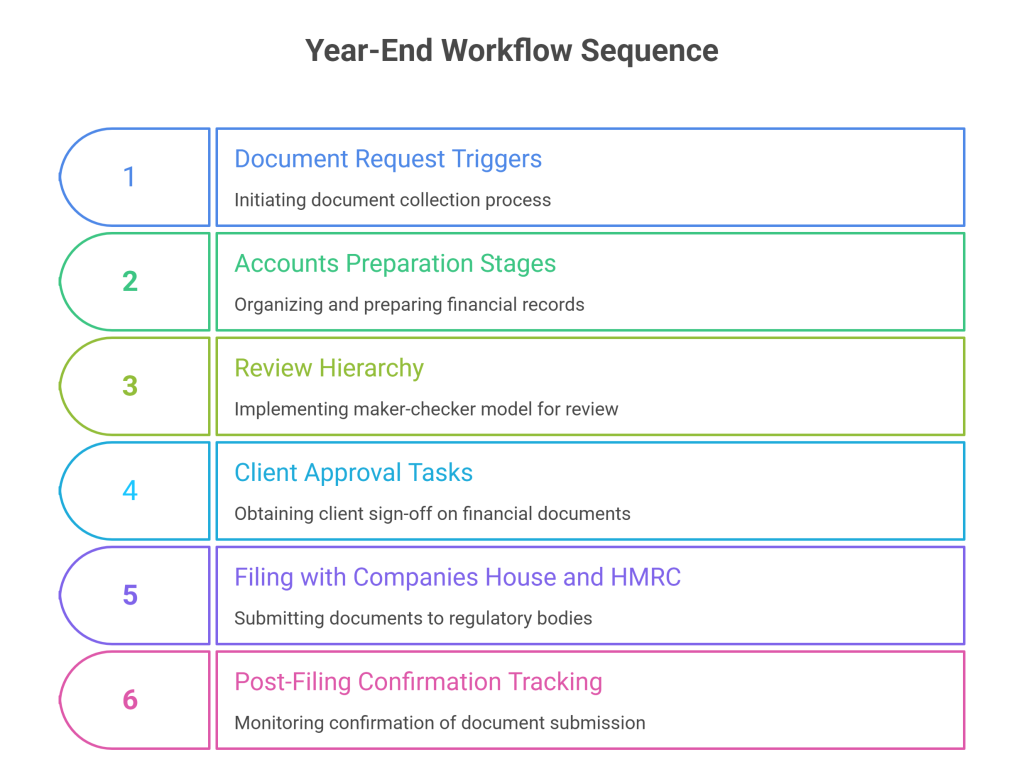
The key is visibility. Partners and managers need to see workload distribution in real time. Accounting workflow automation software provides dashboards that show what is in preparation, what is awaiting review, and what is overdue.
This transforms year-end from a reactive surge into a managed production cycle.
5. Client communication and document requests
“Client chasing” is one of the biggest hidden costs in accounting firms.
Repeated emails asking for bank statements, payroll data or missing invoices drain time and reduce margin. Worse, communication becomes fragmented and untraceable.
Workflow automation for accountants should include:
- Structured client request templates
- Automated reminder sequences
- Status tracking for outstanding documents
- Full communication logs linked to each client record
When document requests are embedded into workflow rather than handled through email alone, firms gain auditability and consistency.
Clients also benefit. They receive clear instructions, defined deadlines and centralised communication rather than scattered messages.
6. Internal review and approvals
Errors rarely happen because staff lack technical knowledge. They happen because processes lack structure.
A maker-checker approval model should not rely on informal handoffs. It should be embedded directly into accounting workflow automation software.
This includes:
- Defined review stages
- Automatic task reassignment upon completion
- Approval logging
- Escalation triggers if reviews exceed time thresholds
AI powered practice management software can enhance this further by flagging anomalies or highlighting incomplete data before it reaches review. However, the core principle remains human control with system-driven structure.
When approvals are systemised, firms reduce rework, protect quality, and maintain compliance, without slowing delivery.
7. Capacity planning and deadline management
Perhaps the most critical workflow to automate is visibility itself.
Many UK firms still rely on spreadsheets to track deadlines, workload and team capacity. As the firm grows, these systems stop scaling.
Accounting workflow automation should provide:
- Real-time deadline dashboards
- Portfolio-level visibility
- Work-in-progress tracking
- Capacity allocation by team member
- Overdue task alerts
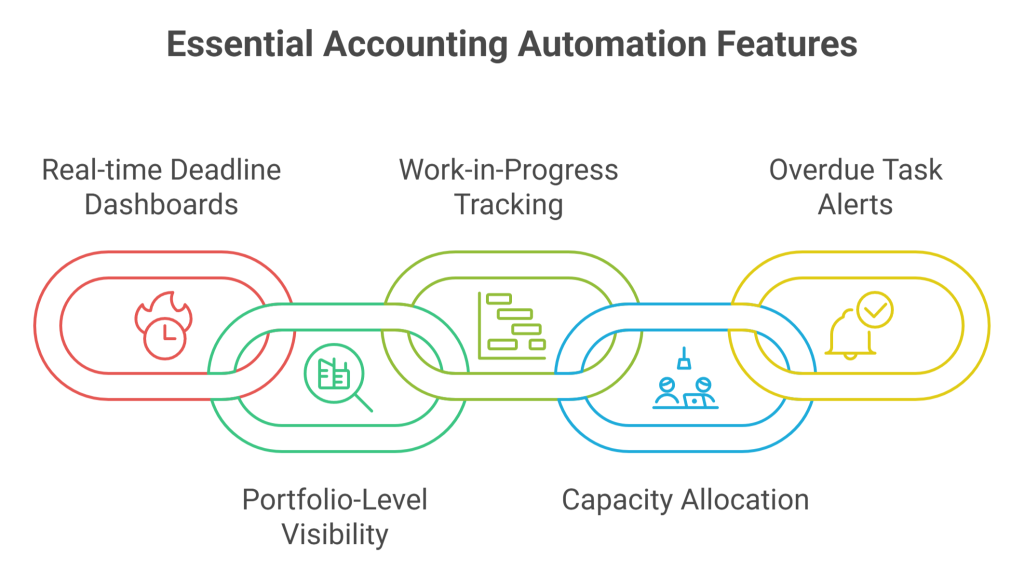
When workflow, client data and deadlines live in one accounting practice management software platform, leaders can make proactive decisions. Work can be redistributed before deadlines are missed. Recruitment decisions can be based on data rather than pressure.
This is where workflow automation becomes strategic rather than operational.
Why systemisation matters more in 2026 and beyond
UK accounting firms face increasing compliance complexity, digital reporting requirements and client expectations for responsiveness.
Manual processes create three major risks:
- Margin erosion through rework and inefficiency
- Staff burnout due to unpredictable workloads
- Compliance exposure caused by missed or undocumented steps
Accounting workflow automation software addresses all three.
It turns your firm into a structured “work factory” where tasks move through defined stages, approvals are recorded, and deadlines are visible. Not rigid, but repeatable.
This does not remove professional judgement. It protects it.
From fragmented tools to one connected workflow
Many firms attempt to solve inefficiency by adding more tools. One system for AML. Another for payroll. A spreadsheet for deadlines. A CRM for onboarding.
The result is fragmentation.
True workflow automation for accounting firms connects onboarding, compliance, bookkeeping, payroll, accounts production and communication inside one system. Data is captured once and flows through every service line.
That is when automation starts driving real ROI.
Final thoughts
Accounting workflow automation is not about chasing the latest trend. It is about building operational resilience.
If your firm wants to scale without increasing chaos, reduce dependency on inboxes and spreadsheets, and maintain compliance under growing regulatory pressure, these seven workflows should not be optional.
They should be systemised.
Modern accounting practice management software makes this possible by combining workflow automation, approvals, deadline visibility and client management in a single connected platform.
The firms that win over the next five years will not simply work harder. They will design systems that allow their teams to deliver consistently, no matter how busy the season becomes.
If you want to explore how structured workflow automation can transform your accounting firm, it may be time to look beyond manual processes and start building a workflow engine that works as predictably as your deadlines.If you’re ready to replace manual handoffs with structured, automated workflows, book a demo or talk to our team to see how Acting Office can help your firm run with full visibility and control.
Frequently Asked Questions About Accounting Workflow Automation for UK Firms
Accounting workflow automation is the systemisation of recurring accounting processes using structured software that automates task routing, approvals and deadline tracking while maintaining full visibility and auditability.
UK accounting firms face fixed HMRC and Companies House deadlines. Accounting workflow automation reduces missed submissions, improves compliance control and creates predictable, repeatable delivery across all service lines.
Accounting workflow automation software builds audit trails into every stage of work. Reviews, approvals and submissions are tracked automatically, reducing compliance risk and undocumented steps.
No. Accounting workflow automation removes manual handoffs and administrative friction so professionals can focus on judgement, advisory work and client relationships rather than chasing tasks.
Yes. By systemising onboarding, VAT, payroll and year-end workflows, accounting firms gain real-time visibility, better capacity management and consistent delivery as client portfolios grow.