





This article examines why aggregation without true operational integration creates serious risks for UK accounting firms, especially in the context of private equity–driven growth. It explains how disconnected systems, fragmented data, and inconsistent workflows undermine efficiency, morale, and client experience, and shows why integration is essential for sustainable scale.
What you’ll learn:
- Why private equity investment is accelerating consolidation in UK accounting
- The operational risks of acquiring firms without integrating systems
- How disconnected software increases costs, errors, and inefficiency
- Why lack of unified data limits visibility and strategic decision-making
- How poor integration impacts staff morale and client experience
- What integrated accounting operations look like in practice
- How a single cloud-based platform supports scalable growth
- Why integration, not aggregation, unlocks long-term value
By focusing on integration rather than simple expansion, accounting firms can turn consolidation into a foundation for efficiency, insight, and sustainable growth.
The accounting industry in the UK is undergoing a rapid transformation, largely driven by the influx of private equity (PE) investment. PE firms have recognised the steady, recurring revenue streams that accounting practices generate and are buying up accounting practices of all shapes and sizes.
However, while the financial appeal is clear, the operational strategy is often left wanting. Acquiring fee income without building cohesive, scalable businesses can result in a patchwork of independently functioning firms.
The Hidden Cost of Disconnected Growth
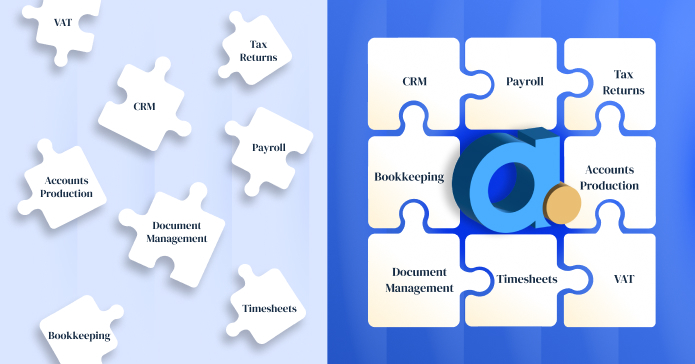
Bringing multiple firms together without integrating their core operations is like assembling a football team where each player speaks a different language.
- Disparate systems lead to duplication of work, disjointed data flows, and inconsistent service delivery.
- Multiple software tools increases training costs, delays reporting, causes duplication of work and the risk of user errors.
- Lack of visibility across business units hinders decision-making, performance tracking, and client management.
- No unified data results in missed opportunities for cross-selling, automation, and strategic insight.
In this environment, operational overheads rise, staff morale dips due to inefficient workflows, and the client experience suffers—all of which eat into the expected gains of an acquisition.
Enter Acting Office: Built for the New Era of Accounting
Acting Office is created with this in mind. It’s a born-cloud, AI powered, full Enterprise software platform, purpose-built for accounting firms navigating growth through consolidation.
Acting Office addresses this problem, by offering everything on a cloud based single platform. From an intuitive client portal to preparing and filing Accounts, Tax returns, Payroll, Company secretarial, VAT, CIS, Bookkeeping, and the list goes on. Unique features include:
- Accabot leverages AI to significantly save time and enhance accuracy in the preparation of accounts and bookkeeping.
- Real-time dashboard view of your entire operations, across all the member firms and different offices of the group.
- Fully Automated features: Auto-client onboarding, Auto-workflows, Auto-document management, Auto-timesheets, Auto-payroll, Auto-filing to Companies House
- Boosts efficiency by 25 to 50%
Acting Office is more than a platform—it’s your partner in building an integrated, future-ready accounting business.
Frequently Asked Questions about Aggregation, Integration, and Growth in Accounting Firms
Without integration, firms operate as disconnected units. This leads to duplicated work, inconsistent processes, higher costs, and reduced visibility across the business.
Private equity often accelerates acquisitions, but without operational integration, firms struggle to scale efficiently and realise the full value of consolidation.
Multiple systems increase training costs, slow reporting, create data inconsistencies, and raise the risk of errors, all of which reduce efficiency and profitability.
Unified data provides visibility across clients, teams, and performance. Without it, firms miss opportunities for automation, cross-selling, and strategic insight.
Inefficient workflows frustrate staff and reduce morale, while inconsistent service delivery negatively impacts the client experience and trust.
True integration means shared workflows, unified data, consistent processes, and real-time visibility across all offices and acquired firms.
Acting Office provides a single cloud-based platform that brings together client management, bookkeeping, tax, payroll, compliance, and reporting in one system.
Accounting firms pursuing growth through acquisition benefit most, especially those aiming to scale efficiently while maintaining service quality and control.